Estonian Cases Explained: All 14 Cases with Examples
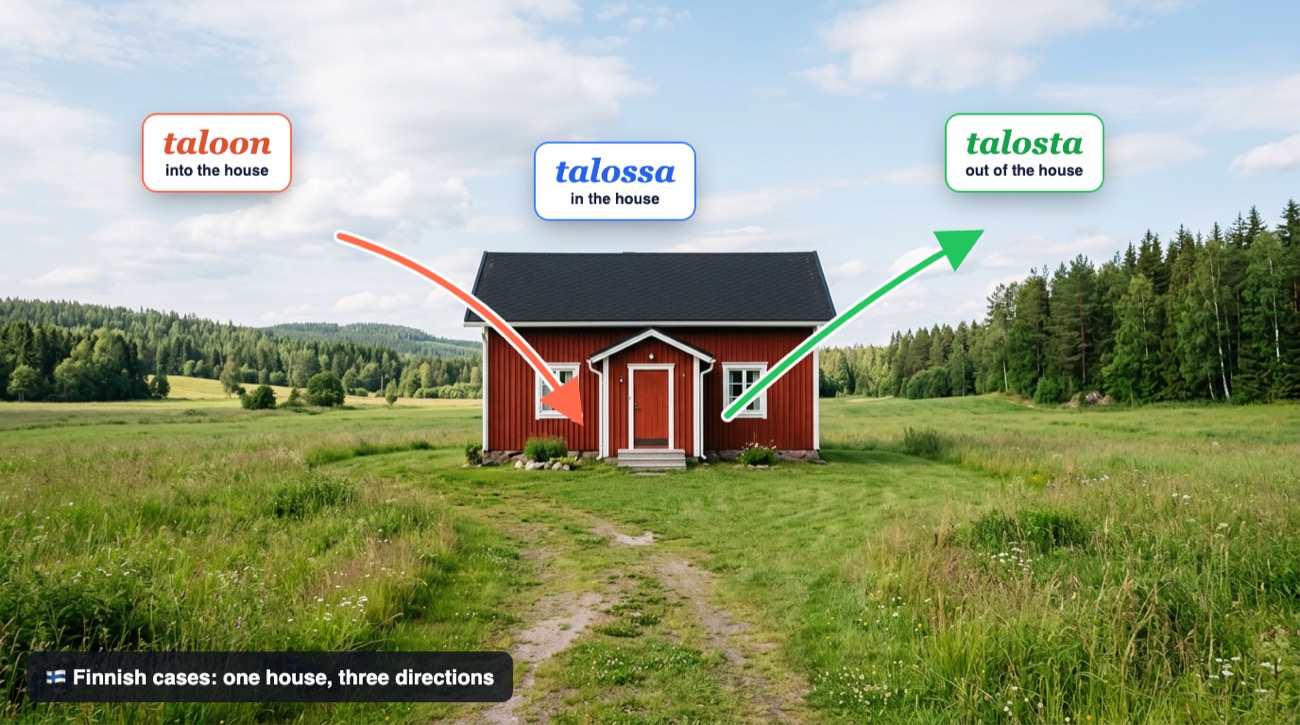
Estonian has 14 grammatical cases, the single fact that gives the language its fearsome reputation. But here is the secret every Estonian learner eventually discovers: the cases are far more regular and far less scary than the number "14" suggests. Eleven of them are built from one stem by adding a predictable ending. This guide walks through all fourteen clearly, grouped the way they actually work, and follows one word, maja (house), through every single case so you can see the whole system at a glance.
Why Estonian has cases (and why it's not as bad as it sounds)
In English, small words carry grammatical meaning: in the house, into the house, out of the house, with the house, without the house. Estonian does the same job by changing the end of the noun instead: majas, majja, majast, majaga, majata. Each English preposition becomes an Estonian case ending.
That is why 14 cases is less work than it looks. You are not learning 14 unrelated forms, you are learning a handful of stems for each word, then attaching regular endings. Master the genitive stem and the case system largely builds itself.
The three foundation cases
These three are the grammatical core. Everything else is built on them, especially the genitive.
1. Nominative (nimetav): the subject
The base dictionary form, with no ending. It marks the subject of the sentence. The plural adds -d.
- Maja on suur. (The house is big.)
- Koer magab. (The dog is sleeping.)
- Majad on ilusad. (The houses are beautiful, plural -d)
2. Genitive (omastav): possession, and the master stem
The genitive answers kelle? mille? (whose? of what?) and marks possession. It has no distinctive ending of its own, it is a bare vowel stem, but it is the most important form in the language, because the six locative cases and the final five cases are all built on the genitive stem. It is also the case governed by most postpositions and used for a completed (total) object.
- See on minu venna auto. (This is my brother's car.)
- Maja katus on punane. (The house's roof is red.)
- Kass on laua all. (The cat is under the table. (postposition all takes the genitive))
3. Partitive (osastav): the partial object
The partitive answers keda? mida? and is the most-used and trickiest case. It marks a part or indefinite quantity, an incomplete or ongoing action, the object of a negated verb, nouns after numbers of two or more, and the object of many specific verbs (armastama to love, ootama to wait for). Its singular ending is -d, -t, or a bare vowel, depending on the word.
- Ma joon vett. (I drink (some) water.)
- Ta sööb leiba. (He is eating bread.)
- Ma ootan bussi. (I'm waiting for the bus.)
- Ma ei taha suppi. (I don't want soup, a negated object)

The six locative cases: where Estonian shines
These six do the work of English in, into, out of, on, onto, off. They split into an interior set (inside something) and an exterior set (on the surface of / at something), and each set has a "to", an "at/in", and a "from" member. All six are built on the genitive stem, so once you know the pattern they are wonderfully systematic.
| Case | Ending | Question | Meaning | Example (maja) |
|---|---|---|---|---|
| Illative (sisseütlev) | -sse | kuhu? | into | majja / majasse |
| Inessive (seesütlev) | -s | kus? | in / inside | majas |
| Elative (seestütlev) | -st | kust? | out of | majast |
| Allative (alaleütlev) | -le | kuhu? | onto / to | majale |
| Adessive (alalütlev) | -l | kus? | on / at | majal |
| Ablative (alaltütlev) | -lt | kust? | off / from | majalt |
Notice the elegant symmetry: interior -sse / -s / -st mirrors exterior -le / -l / -lt. Three directions (to, at, from) times two surfaces (inside, on top) equals the six locatives.
- Ma elan majas. (I live in a house. (inessive))
- Ta läheb majja. (He goes into the house. (illative, short form))
- Nad tulevad majast. (They come out of the house. (elative))
- Raamat on laual. (The book is on the table. (adessive))
- Ma panen raamatu lauale. (I put the book on the table. (allative))
- Ma sain sõbralt kirja. (I got a letter from a friend, ablative)

The adessive does double duty: Estonian has no verb "to have", so possession is expressed with the adessive plus on: Mul on aega, literally "on-me is time", meaning "I have time".
The final five cases
These also build on the genitive stem, each with one clear ending. One quirk worth knowing: with the last four (terminative, essive, abessive, comitative), an adjective in front stays in the genitive, only the noun takes the ending: suure majaga (with the big house).
10. Translative (saav): becoming / into a role · -ks
Answers kelleks? milleks?, marks a change of state, role, or purpose, and points of time by which.
- Ta sai õpetajaks. (She became a teacher.)
- Ma õpin arstiks. (I'm studying to be a doctor.)
- Tee töö homseks valmis. (Get the work done by tomorrow.)
11. Terminative (rajav): up to / until · -ni
Answers milleni?, marks a limit in space or time.
- Ma töötan õhtuni. (I work until evening.)
- Rong sõidab Tartuni. (The train goes as far as Tartu.)
12. Essive (olev): as / in the role of · -na
Answers kellena?, marks a temporary role or capacity.
- Ta töötab õpetajana. (She works as a teacher.)
- Lapsena elasin maal. (As a child I lived in the countryside.)
13. Abessive (ilmaütlev): without · -ta
Answers milleta?, the opposite of "with". Often paired with the preposition ilma.
- Ilma rahata ei saa midagi osta. (Without money you can't buy anything.)
- Ta lahkus sõnagi lausumata. (He left without saying a word.)
14. Comitative (kaasaütlev): with · -ga
Answers kellega? millega?, marks accompaniment and instrument (with someone / by means of something). This is one of the most useful cases for beginners.
- Ma sõidan bussiga tööle. (I go to work by bus.)
- Ta läks sõbraga kinno. (He went to the cinema with a friend.)
- Ma kirjutan pliiatsiga. (I write with a pencil.)
All 14 cases at a glance: maja (house)
Here is the full singular paradigm of maja, the entire case system in one place. Note how the first three forms happen to be identical for this word (maja), and how every later case is the genitive stem maja- plus an ending.
| # | Case | Estonian name | maja (singular) | Rough meaning |
|---|---|---|---|---|
| 1 | Nominative | nimetav | maja | house (subject) |
| 2 | Genitive | omastav | maja | of the house |
| 3 | Partitive | osastav | maja | (some) house / object |
| 4 | Illative | sisseütlev | majja / majasse | into the house |
| 5 | Inessive | seesütlev | majas | in the house |
| 6 | Elative | seestütlev | majast | out of the house |
| 7 | Allative | alaleütlev | majale | onto the house |
| 8 | Adessive | alalütlev | majal | on / at the house |
| 9 | Ablative | alaltütlev | majalt | off / from the house |
| 10 | Translative | saav | majaks | into a house (becoming) |
| 11 | Terminative | rajav | majani | up to the house |
| 12 | Essive | olev | majana | as a house |
| 13 | Abessive | ilmaütlev | majata | without a house |
| 14 | Comitative | kaasaütlev | majaga | with the house |
The one complication: consonant gradation
Many Estonian words are not as tidy as maja. Their stem changes between a strong and a weak grade as they inflect, a process called consonant gradation. For example tuba (room) has the genitive stem toa-, so its cases are toas (in the room), tuppa (into the room), toast (out of the room), toaga (with the room). The endings are exactly the same as for maja, but you have to know the genitive stem first. This is why learning three "principal parts" (nominative, genitive, partitive) for each new word is the standard, effective way to learn Estonian nouns.
How to actually learn the Estonian cases
- Master the genitive first. Eleven cases are built on it. Learn every noun together with its genitive stem.
- Learn the six locatives as two mirrored sets, interior -sse/-s/-st and exterior -le/-l/-lt. They are the highest-value cases for everyday life.
- Drill the partitive separately. It is irregular and the object system depends on it. Treat it as a principal part, not something to guess.
- Learn each noun's three principal parts (nominative / genitive / partitive) so gradation never surprises you.
- Use real sentences, not tables. The paradigm above is a map; fluency comes from building sentences until each ending feels automatic.
Practice all 14 Estonian cases with dedicated drills
EstoniaSpeak has grammar lessons and exercises for every case, with examples, audio, and clear explanations built for English speakers.