Estonian vs Finnish: How Similar Are They Really?
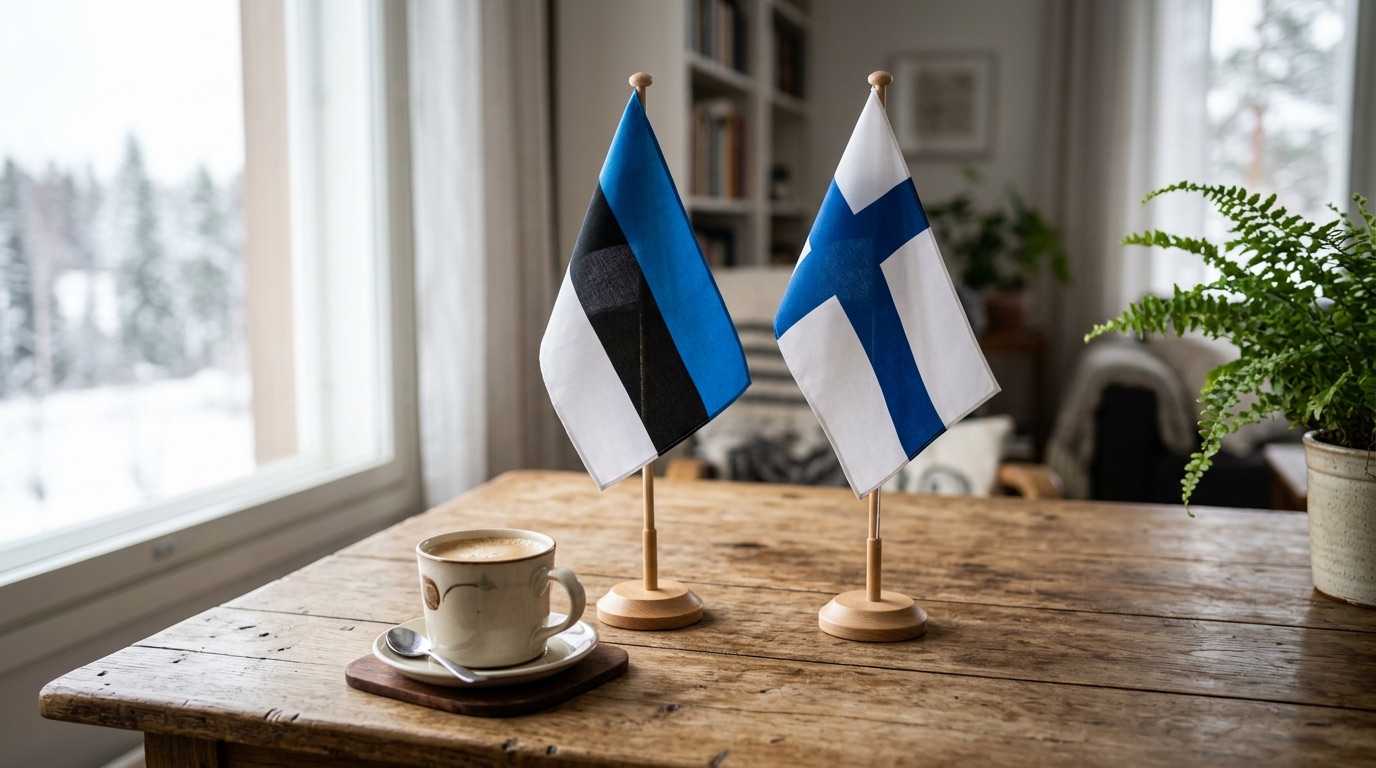
Estonian and Finnish face each other across the Gulf of Finland, and on the language family tree they are close cousins, both Finnic languages of the wider Uralic family, descended from the same ancestor. They share a great deal: the same case-based architecture, agglutination, no grammatical gender, no articles, and that famously tricky partitive case. Yet they are not two dialects of one language. Centuries of separate development, and centuries of heavy foreign influence on Estonian, pushed them apart. Here is the honest picture of how alike, and how different, they really are.
How related are Estonian and Finnish?
Estonian and Finnish are sister languages descended from Proto-Finnic. Crucially, they are not Indo-European: they belong to the Uralic family, whose relatives include Hungarian (a distant cousin) and several smaller languages of the Baltic region and Russia. That means neither language is closely related to English, Swedish, or Russian, despite geographic proximity.
A useful rough comparison is Spanish and Italian: recognisably related, with shared roots you can spot on the page, but requiring real study to actually converse. A speaker of one can guess at the meaning of simple written sentences in the other, but spoken conversation quickly runs into trouble.
| English | Estonian | Finnish |
|---|---|---|
| language | keel | kieli |
| water | vesi | vesi |
| house | maja | maja / talo |
| hand | käsi (kätt) | käsi (kättä) |
| to read | lugema | lukea |
| I am | ma olen | minä olen |
| book | raamat | kirja |
| town / city | linn | kaupunki |
Notice two things. First, core words like vesi (water) can be identical. Second, everyday words like "book" or "town" can be completely different, because Estonian and Finnish borrowed and innovated separately.
What the two languages share
The shared Finnic skeleton is substantial, and it is the reason the languages feel like relatives rather than strangers.
A large case system
Both languages mark a noun's role in the sentence with grammatical cases rather than with word order or prepositions. Estonian has 14 cases; Finnish has 15. Many of them line up closely in function, the inessive ("in"), elative ("out of"), illative ("into"), adessive ("on/at"), and the rest of the locative series exist in both.
Agglutination
Both stack endings onto a stem to build meaning, so a single word can carry information that English spreads across several. Estonian majades means "in the houses", stem maja + plural + inessive, all in one word.
No gender, no articles
Neither language has grammatical gender, and neither has "a," "an," or "the." Estonian tema and Finnish hän both cover "he" and "she" without distinction. Definiteness is inferred from context or expressed through case and word order.
The partitive case
The single most important shared feature, and the hardest for learners of either language, is the partitive. It marks partial or indefinite quantity, the object of an ongoing or incomplete action, negated objects, and objects of many specific verbs. Estonian Ma joon vett and Finnish Juon vettä both use the partitive for "I drink (some) water." Mastering the total-versus-partial object contrast is a rite of passage in both languages.
Where Estonian and Finnish diverge
The differences are what stop this from being a case of two dialects. Several are structural, not just vocabulary.
Estonian lost vowel harmony
Finnish has vowel harmony: back and front vowels cannot mix in a word, so endings come in pairs like -ssa/-ssä. Estonian abandoned this entirely, its endings have a single form. This actually simplifies Estonian in one respect, but it means a Finnish speaker's instinct for which vowel an ending "should" have is useless.
Three quantity degrees
Finnish distinguishes short and long sounds (two degrees). Estonian has three contrastive length degrees, short (Q1), long (Q2), and overlong (Q3), and this length is phonemic: it changes meaning. The catch is that the overlong degree is often not shown in spelling. The written word linna can mean "of the town" (long) or "into the town" (overlong), told apart only by how long you hold the sound.
More lexicalized consonant gradation
Both languages alternate consonants between "strong" and "weak" grades as words inflect (Estonian tuba "room" → toa "of the room"). In Finnish these alternations are fairly regular; in Estonian they are far more lexicalized and irregular, sometimes even "reversed." In practice, Estonian gradation has to be learned word by word.
The quotative mood
Estonian has a distinctive quotative (reported) mood, marked with -vat, used to report hearsay, information you did not witness yourself. Ta olevat rikas means "he is said to be rich." Finnish has no direct equivalent; it expresses reported speech with separate constructions. For a Finn learning Estonian, this is a genuinely new grammatical category.
Shorter, apocopated words
Estonian dropped many final vowels and endings that Finnish preserved, a process called apocope. The result is that Estonian words are often shorter and can look "worn down" compared with their Finnish counterparts. Finnish kättä corresponds to Estonian kätt ("hand," partitive); Finnish keeps the final vowel, Estonian clips it. These lost vowels also make Estonian's gradation and length patterns harder to read off the spelling.
| Feature | Finnish | Estonian |
|---|---|---|
| Vowel harmony | Yes (-ssa / -ssä) | None, single ending |
| Quantity degrees | 2 (short / long) | 3 (short / long / overlong) |
| Consonant gradation | Fairly regular | Lexicalized, irregular |
| Negation | Verb conjugates (en / et / ei) | Invariant ei + connegative |
| Final vowels | Preserved (kättä) | Apocope (kätt) |
| Reported / evidential mood | No | Quotative -vat |
| Number of cases | 15 | 14 |
| "to be," 3rd person | on / ovat | on / on |
False friends: words that betray you
Because the languages share roots, they are riddled with false friends, words that look or sound alike but mean something different, sometimes hilariously so. These are exactly the words most likely to trip up a Finn in Estonia (and vice versa).
- halb, In Estonian this means "bad." In Finnish, halpa means "cheap." A cheap deal is not a bad one.
- hallitus, In Finnish, "government." In Estonian, hallitus means "mould" (the kind that grows on old bread).
- viina, Estonian viin is "vodka / spirits"; Finnish viina is strong liquor generally, but Finnish viini is "wine." Ordering the wrong one has consequences.
- raamat, Estonian for "book." The Finnish look-alike raamattu specifically means "the Bible."
- pulma, In Estonian, pulm is a "wedding." In Finnish, pulma is a "problem." Draw your own conclusions.
- sula, In Estonian, related to melting/thaw; the classic warning tale is that everyday words for things like clothing, food, and hospitality diverge just enough to cause confusion at the dinner table.
These false friends are a big reason Finns and Estonians often report understanding "about half" of each other, enough to feel confident, and enough to get it comically wrong.
So, can a Finnish speaker understand Estonian?
Up to a point. A Finnish speaker with no prior exposure can usually read a simple Estonian sign, guess the gist of a headline, and recognise many everyday words. Shared grammar means the sentences are built the same way, so the structure feels familiar. But fluent understanding does not come for free: the missing vowel harmony, the three-way length that spelling hides, the apocopated forms, the quotative mood, and the false friends all add up. Spoken Estonian at natural speed is genuinely hard for an untrained Finn to follow.
The good news for learners is that if you already know one of these languages, the other is dramatically easier to pick up than starting from scratch, the shared cases, partitive logic, and agglutinative structure transfer directly. And if you know neither, Estonian is a rewarding place to start: a compact, logical Finnic language spoken by a tech-forward nation.
Learn Estonian with a structured, grammar-first path
EstoniaSpeak teaches Estonian from A1 to C1, all 14 cases, the partitive, consonant gradation, real audio, and spaced repetition. Built specifically for Estonian, not a generic template.